
Khushi Sameer Sikka is a second-year master’s student at the Department of Geopolitics and International Relations, Manipal Institute of Social Sciences, Humanities and Arts, Manipal Academy of Higher Education (Institution of Eminence), Manipal, India.
In the 21st century, the international order is increasingly defined not by rigid alliances; but through strategic partnerships built around trade, technology and connectivity. For decades, West Asia was shaped by a strategic bargain in which the United States (US) provided security while the Gulf states supplied oil. However, this equation is being rewritten. China, which was once an ordinary and quiet energy customer, has now emerged as one of the prominent players in the region. The growing relations between China and the Kingdom of Saudi Arabia (KSA) reflects more than just a regular bilateral relationship. It signals a broader shift in the global geopolitics, which is driven by technology, green finance and economic connectivity. What makes this relationship noteworthy is not just its rapid expansion, but the way it reflects a broader shift in how power is exercised in the 21st Century. Unlike traditional alliances built on military commitments, the Sino-Saudi ties reflect a partnership which is flexible, multi-layered, and driven by shared economic and technological interests rather than binding defence obligations. It is precisely this flexibility that makes it both effective and, for some, unsettling.
China and Saudi Arabia had virtually no formal interactions until the late 1980s, and the relationship was largely shaped by Cold War dynamics, ideological differences and Saudi Arabia’s recognition of Republic of China (ROC) instead of People’s Republic of China (PRC). However, a major turning point came in the year 1986, when Saudi Arabia signed a secret deal with PRC to purchase 50 Chinese intermediate range ballistic missiles worth US$3.5 billion. This defence cooperation between the two led to the very first engagement, and it paved the way for the establishment of official diplomatic relations – on 21st July 1990, Saudi Arabia formally recognised PRC and started following the “One China Policy”. Since then, the bilateral ties have expanded steadily and have evolved into Comprehensive Strategic Partnership in 2016, one of the highest categories of diplomatic partnerships in China’s foreign relations framework.
Over the past three decades, Sino-Saudi ties have evolved, and have moved beyond the traditional oil trade. The relations between the countries can broadly be categorised into three phases. For much of the 1990s to the early 2000s, the relationship between the two countries was largely energy centric. As China’s economy expanded rapidly, its dependence on imported oil increased, making Saudi Arabia one of its most important energy suppliers. However, the relationship entered a new phase after 2012, as the cooperation went beyond mere oil trade. In the year 2012, China’s Premier Wen Jiabao’s visit to Saudi Arabia led to the signing of several cooperation agreements covering energy and nuclear technology for peaceful purposes and infrastructure development.
Under Xi Jinping, in the year 2014, a “1+2+3 Cooperation Pattern” was introduced by China at the China-Arab Cooperation Forum held in Beijing. This Cooperation Pattern provided an architectural blueprint for China’s economic and diplomatic engagement with Saudi Arabia and the other Gulf countries. Within this model, “1” represents energy which has been the central pillar of cooperation between the two; “2” refers to two wings of cooperation which are infrastructure construction and trade and investment facilitation; and “3” denotes cooperation in the three high technology areas: nuclear energy, space satellites and renewable energy. This model was introduced within the context of Belt and Road Initiative (BRI) and highlighted the transition from regular oil trade towards a broader and more integrated strategic partnership.
Xi Jinping’s visit to the Kingdom in 2016 led to the elevation of ties to Comprehensive Strategic Partnership. This convergence altered the nature of bilateral cooperation; it also led to the convergence of BRI with Saudi Arabia’s “Vision 2030”, a comprehensive economic and social reform programme unveiled in April 2016 by Crown Prince Mohammed bin Salman (MBS). This initiative was designed to reduce Saudi Arabia’s dependence on oil and transform the Kingdom into a diversified innovation driven economy through investments in technology, renewable energy, green technology, tourism, digital infrastructure and attracting foreign investments. This convergence marked an important shift in the trajectory of Sino-Saudi relations. While energy continued to remain the foundation of cooperation, both countries increasingly recognised the limitations of an oil-dependent partnership in a rapidly changing global economy. Riyadh, through its Vision 2030, sought to diversify its economy by investing in technology, smart infrastructure, renewable energy and digital transformation. At the same time, Beijing under Xi Jinping was expanding the scope of the BRI beyond physical infrastructure towards technological connectivity and sustainable development. These complementary objectives created the basis for deeper cooperation in emerging sectors.
It was within this context that the Digital Silk Road (DSR), introduced in 2015, and the Green BRI, formally promoted in 2017, became significant pillars of Sino-Saudi engagement. Through the DSR, Chinese companies have started to play major role in various sectors like telecommunication, cloud infrastructure, fintech and finance, space cooperation, and Artificial Intelligence. In the telecommunication sector, Chinese companies like Huawei technologies and ZTE are collaborating with the major Saudi telecom service providers like Mobily and Zain KSA to expand 5G standalone network towers. Huawei also facilitates the use of 600 MHz spectrum to improve uplink capacity and lower latency. In terms of cloud infrastructure, Huawei cloud region was established in Riyadh in 2023, and Chinese company Alibaba has collaborated with Saudi Cloud Computing Company in establishing Alibaba Cloud. In the fintech sector, Chinese companies like Alipay+, WeChat pay and YeePay are actively collaborating with the local banks to facilitate digital transactions in the country. Saudi Arabia’s SAMA (Saudi Arabia Monetary Agency) joined the mBridge project along with China, Hong Kong, Thailand and UAE to enable instant, low cost, cross border payments and foreign exchange transactions using the blockchain technology.
In the space sector, the BeiDou Navigation Satellite has emerged as a viable alternative to the US’ Global Positioning System (GPS), as it offers high precision, navigation and timing service. It has an accuracy of 10cm in contrast to GPS which offers an accuracy of only 30cm in the same region. Huawei is also collaborating in establishing Large Language Models in Arabic language. Another important sector of cooperation is the development of smart cities. Through the implementation of 5G networks and Internet of Things (IoT) systems, as well as AI-based solutions, Chinese companies, specifically Huawei, have helped to develop smart city capabilities in projects like the King Abdullah Financial District (KAFD). NEOM – a giga project of Saudi Arabia – is another example which serves as a primary site for the development of DSR technologies, ranging from Huawei’s 5G networks and Hikvision’s AI-surveillance to the integration of BeiDou-enabled logistics.
Similarly, China has attempted to position itself as a global leader in green development and renewable energy production under the framework of the Green BRI. This convergence has created new opportunities for cooperation in solar energy, green hydrogen and sustainable urban development. Chinese companies such as Jinko Solar, LONGI Green Energy Technology and Power Construction Corporation of China have increasingly expanded their role in Saudi Arabia’s renewable energy sector. China’s expertise in solar panel manufacturing, battery storage and energy infrastructure aligns closely with Saudi Arabia’s ambition to become a regional hub for clean energy production. Green hydrogen projects in regions such as NEOM and Yanbu further demonstrate how the relationship is gradually moving beyond traditional oil dependency towards future-oriented energy cooperation. The following table shows the involvement of major Chinese companies in the Kingdom on various projects.
Figure 1: Chinese Companies involved in Construction of Sustainability Projects
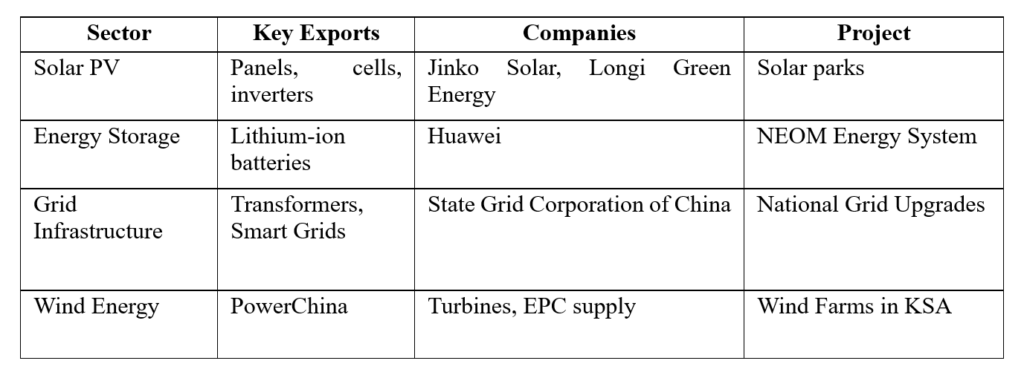
Source: Compiled by author with data from Reuters (2025)
However, the rapid expansion of Sino-Saudi cooperation has also generated concerns in Washington. For decades, the alliance between the US and Saudi Arabia was built upon a strategic bargain centred on oil and security. China’s growing presence in sectors such as 5G infrastructure, artificial intelligence, cloud computing, and critical infrastructure has challenged this traditional equation. The US has repeatedly expressed concerns regarding Huawei’s role in Gulf telecommunications infrastructure, arguing that Chinese digital systems could create long-term security and intelligence risks. Similarly, expanding cooperation in emerging technologies and renewable energy has intensified fears in Washington that Beijing is gaining strategic influence in a region historically dominated by the United States.
Yet, Saudi Arabia has carefully avoided choosing between Washington and Beijing. Instead, Riyadh has increasingly pursued a strategy of diversification and strategic hedging, maintaining its security partnership with the US, while simultaneously deepening economic and technological cooperation with China. From Beijing’s perspective, Saudi Arabia occupied central position in China’s Middle East Strategy as a reliable energy supplier, a key partner in BRI, and an important gateway for expanding Chinese technological, financial and infrastructure investments in the Gulf region. By strengthening ties with Riyadh, China seeks to enhance its energy security, expand its economic footprint, and increase its influence in a strategically important region without becoming directly involved in the regional security commitments. This engagement also forms a part of its broader strategy of securing the critical Sea Lines of Communication (SLOCs) and strengthening its influence across the Indian Ocean and West Asia through the initiatives of BRI. In many ways, the evolution of Sino-Saudi relations reflects the emergence of a more multipolar West Asia, where influence is no longer determined solely through military alliances, but increasingly through technology, connectivity and economic interdependence.
The rise of Sino-Saudi relations reflects a broader transformation in the international order, where economic connectivity, technology and strategic flexibility are becoming as important as traditional military alliances. What began as a purely energy-driven relationship has evolved into a multidimensional partnership encompassing digital infrastructure, renewable energy, artificial intelligence and smart city development. At the same time, the partnership highlights Saudi Arabia’s growing effort to diversify its foreign relations and China’s expanding influence in West Asia. Ultimately, the evolution of Sino-Saudi ties demonstrates how power in the 21st Century is increasingly exercised through technology, investment and interdependence rather than solely through security commitments.
Disclaimer: The views expressed in the article are personal.