Shivesh Mehta is a second-year master’s student at the Department of Geopolitics and International Relations, Manipal Institute of Social Sciences, Humanities and Arts, Manipal Academy of Higher Education (Institution of Eminence), Manipal, India.
Trade and transport corridors have evolved from being simple platforms of movement to sophisticated instruments of statecraft and power projection and this evolution has fundamentally altered the modern geopolitical landscape. In the 21st century, connectivity is increasingly becoming a major physical means of demonstrating global power. A nation that is well connected by land and sea routes, makes for itself an undeniable place in the global forum. China is a nation that is the perfect example of this unsaid law. China’s Belt and Road Initiative (BRI) is the most widely spread trade and transport corridor network in the world today. The map below shows the routes of the BRI.
Figure 1. The Belt and Road Initiative
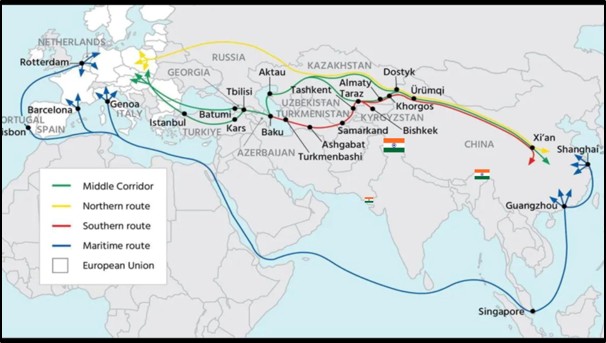
Source: Modified by the author from Paterson (2024)
- Northern Corridor: Trade and transport route connecting China and Europe through Russia (and often Belarus). This was, until recently, the shortest overland link between East Asia and European markets.
- Middle Corridor: Eurasian trade and transport route connecting China and Europe through Kazakhstan, the Caspian Sea, Azerbaijan, Georgia, and Turkey.
- Southern Corridor: Connects Asia and Europe through Iran and the Persian Gulf region.
- Maritime Corridor: Sea-based route connecting Asia and Europe through major points such as Strait of Malacca, Bab-el-Mandeb, Suez Canal and the Mediterranean Sea.
Amongst these four routes, the Northern Corridor, or as it is formally known, the Northern Europe-Land Bridge (NELB) was the most widely subscribed channel of commute by travelers and freight moving corporations. It was categorized as goldilocks trade route due to its combination of faster transport speed than sea transport and lower transport costs than air transport. However, systemic fragmentations have triggered a radical paradigm shift. As a result of the war in Ukraine in 2022 and the military aggression of USA on Iran in 2026, traditional Northern and maritime routes are now stranded assets from the point of view of trade. Thus, the Trans-Caspian International Transport Route (TITR), popularly known as the Middle Corridor, has become more than a secondary option – it has become a logistical necessity for Eurasian trade.
Rise and Fall of the Northern Corridor
Once the crown jewel of Silk Road Economic Belt, the NELB is now transforming into a redundant project. It was the crown jewel because it bypassed the tyranny of distance and connected the centers of China’s industry, such as Chongqing and Xi’an directly with the European markets through Russia and Belarus.
Figure 2. Rise and Fall of Trade on the NELB (in TEUs)
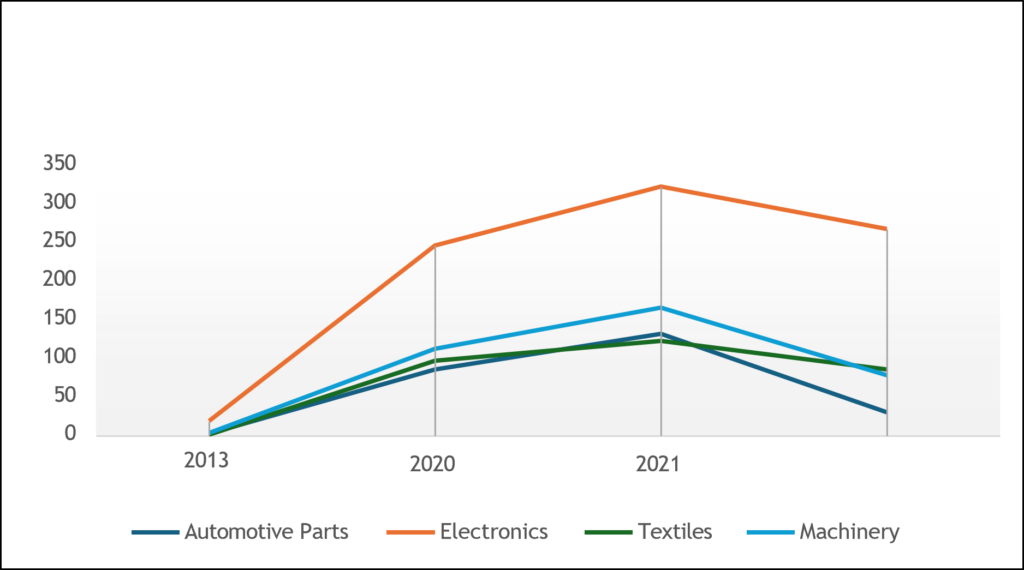
Sources: Created by the author using data from UTLC ERA (2026)
The figure above is a clear depiction of the rise and fall of trade on the NELB. It captures the trade volumes of the top four commodities that move onto the NELB. It is clearly visible that there was a significant drop in the freight volumes post 2021, and that was the time the Russia-Ukraine tensions heightened and eventually broke out into a war. It was at its peak in the period between 2020 and 2022, when 90% of all rail freight traffic between China and Europe was carried – this was when the NELB proved to be essential in times of pandemic-related maritime disruption.
The attack on Ukraine in 2022, however, brought about a long-term structural downturn. European stakeholders were looking to de-risk their supply chains from Russian dependent infrastructure, leading to a decline in Westbound traffic of more than 22% in 2025. This was institutionalized by international insurance companies such as the Lloyds of London and Zurich who established war zone exclusions in their policies, turning a previously predictable logistical coup into a stranded asset to the Western geopolitical psyche.
The Middle Corridor as a Geopolitical Bypass
The viability of the Northern Route weakened, giving rise to a new geopolitical route, the TITR, or Middle Corridor. The TITR is not a linear rail route like that in the North, but rather a multi- modal land-sea route between China and Europe via Kazakhstan, Caspian Sea and the Caucasus. The path has strategic significance for Beijing – it helps to reduce the Malacca Dilemma without passing through active war zones (Russia-Ukraine and US-Iran).
Figure 3. Rise of Trade on TITR (in TEUs)
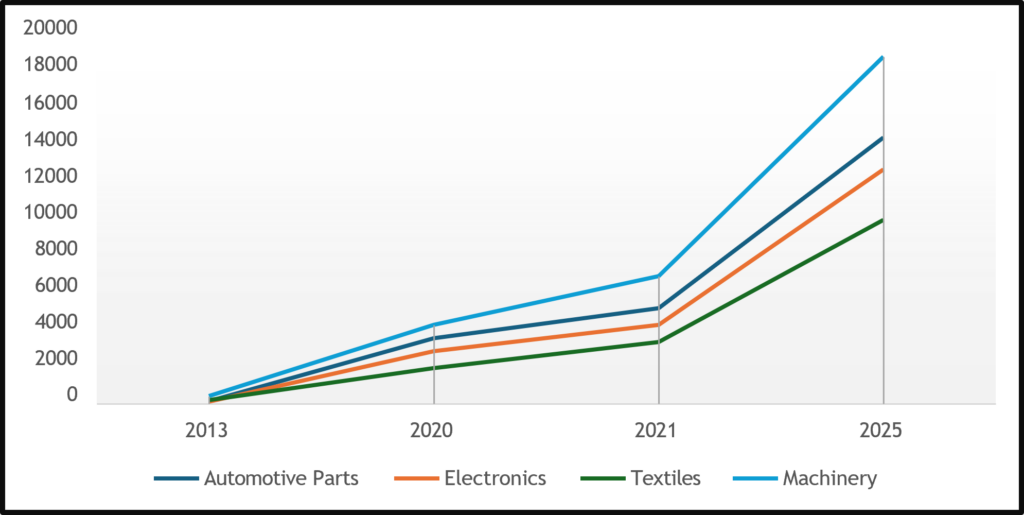
Source: Created by the author using data from UTLC ERA (2026)
The figure above shows the rise in subscription by corporations for freight movement on the Middle Corridor. It is visible that after a slow rise in freight volumes from 2013-2021, there is a sharp increase in the materials moved on it. The TITR has also began to move about 5% of China’s oil imports, as it bypasses potentially vulnerable maritime channels which is an issue that the maritime route of BRI is unable to find a solution to. It is also trusted by China in order to diversify its import routes to avoid absolute dependence on just one channel.
The corridor is also a means for geo-spatial compression (GSC) and theoretically speaking, compresses markets and political centers near each other thanks to the high-speed road networks. For Central Asian Republics, this shift sets new landmarks in landlocked isolation, to become the new ventricles of trans-continental trade, with a land-linked competitive advantage.
Hard and Soft Infrastructure
For the Middle Corridor to be viable in operation, it is necessary to develop a combination of hard physical elements and soft regulatory structures. One of the main technical achievements is the Khorgos Gateway in the Chinese-Kazakh border, which is dubbed as the “buckle” of the BRI. In this case, an automated gantry crane is moving containers from one rail gauge to another in only 47 minutes, breaking the precedent that was previously set by the break-of- gauge problem in trans-continental trade.
It is supported by a Global Value Stack, the vertical stack of 5G-enabled logistics software, digital twins and customs rules in a blockchain. These technical standards provide an opportunity to transit states such as Azerbaijan and Kazakhstan to decrease administrative friction and harmonize the time of ships and rails on the Caspian Sea. As a result, this digital integration generates a goldilocks zone for logistics: quicker than maritime (15 days vs. 35 to 45 days) and much less expensive than air freight for high-value goods such as automotive parts and electronics; thus delivering the rhythm that is essential to high-value industries.
2026 US-Iran War: An Apt Stress Test
In early 2026, military conflict between the United States and Iran caused the pivot to the Middle Corridor to happen in an explosive manner. The war effectively blocked the traditional shipping lanes in the Persian Gulf and through the Strait of Hormuz, making them almost impossible to use for international trade due to the recurring cases of attacks on ships.
Southern shipping lines, which were thought to be the lifeline of the world’s trade, were effectively deserted by the major international insurance companies such as Lloyds of London, AXA XL and Zurich who placed war-zone exclusions on these shipping lanes (all water areas withing 12 nautical miles of listed countries/territories are out of bounds for cargo ships).
The TITR turned from a hypothetical second-best to the primary, high-speed option in this context of unreliability. Now it is the sole remaining land route that can ensure safe passage between Chinese industrial hubs and the European consumer markets without crossing an active conflict zone. This crisis has, in a fundamental way, reshaped the corridor as a strategic break for the future of Eurasian land-based trade.
Rise of Logistics States
The reintegration of trade in Eurasia has led to a rapid process of industrial power decentralization and as a result to the rise of formerly non-sea-going countries to become high functioning logistics states. Countries like Azerbaijan, Georgia, Kazakhstan, have become not only transit areas, but a working artery of a new world. Through the Middle Corridor, these countries have acquired a new strategic independence of sorts, and this has enabled them to break free from the historical geopolitical domination of the classic ones in the region.
This transformation can be supported by the massive capital inflows, such as $846 million, allocated to Kazakhstan by the World Bank and Asian Infrastructure Investment Bank allocation of $546 million for modernization of the country’s rail network. Currently there are Special Economic Zones (SEZs) in these states where value-added production and just in time (JIT) manufacturing is flourishing. This change reflects the Developmental Peace approach in which the major underpinning pillars of regional stability are hard infrastructure and economic integration. Thus, in the 21st century, the power to manage the movement of goods has come to be identified with power over the region traversed by the route under control.
It can’t be denied that in the 21st century, connectivity has emerged as a decisive instrument of geopolitical power as seen by the evolution of the trade corridors in Eurasia. The Northern Corridor’s fall due to the ongoing war between Russia and Ukraine, as well as the weaknesses of the maritime corridors resulting from the US-Iran conflict, have altered the reality of global trade. In this ever-changing landscape, the Middle Corridor has emerged, not solely as an alternative trade and transport route, but also as a strategic need for ensuring resilient connectivity between Asia and Europe. Incorporated with investments in infrastructure both physical and digital, the corridor is transforming the supply chains, lowering geopolitical vulnerabilities and raising the Central Asian states to prominent roles in the global economy.
In conclusion, the development of the Middle Corridor represents a much larger pattern in geopolitics and international trade where the capacity to control and move goods and people supplies a new path to economic leverage, strategic independence and global power.
Disclaimer: The views expressed in the article are personal.